# Why China's Metro Systems Are a Game-Changer
If you're coming to China as an international student, here's the good news: you're about to experience some of the most advanced, efficient, and affordable public transportation systems in the world. China has invested massively in urban rail transit over the past two decades, and the results are nothing short of extraordinary.
As of 2026, over 50 Chinese cities have operational metro systems, with a combined network length exceeding 10,000 kilometers. To put that in perspective, that's more than the rest of the world's metro systems combined. Whether you're studying in Beijing, Shanghai, Guangzhou, Chengdu, or any other major city, the metro will likely become your primary mode of transportation — and for good reason.
A single metro ride typically costs between 2-10 RMB (roughly $0.30-$1.40 USD), making it dramatically cheaper than taxis or ride-hailing services. Trains run every 2-5 minutes during peak hours, stations are clean and well-maintained, and the signage is bilingual (Chinese and English) in all major cities.
# Metro Systems by City: What to Expect
# Beijing Subway (北京地铁)
Beijing's metro is one of the world's busiest, carrying over 10 million passengers daily. With 27 lines and more than 470 stations, it covers virtually every corner of the capital. Key features for students include direct connections to all major university districts (Haidian, Chaoyang), the airport express line to Capital International Airport, and extensive coverage of tourist sites like the Forbidden City, Temple of Heaven, and the Summer Palace.
The flat fare starts at 3 RMB for rides up to 6 km, with incremental increases based on distance. A typical cross-city journey rarely exceeds 8 RMB.
# Shanghai Metro (上海地铁)
Shanghai boasts the world's longest metro network by total route length. With 20 lines and over 500 stations, it's a marvel of urban engineering. The system connects seamlessly to both Pudong International Airport (via Line 2 and the Maglev) and Hongqiao Airport/Railway Station (via Lines 2, 10, and 17).
Shanghai's metro is particularly student-friendly, with stations near every major university and extensive late-night service on weekends. Fares start at 3 RMB and are distance-based.
# Guangzhou Metro (广州地铁)
Guangzhou's metro is known for its speed and reliability. The system serves as a gateway to the entire Pearl River Delta region, with intercity connections to Shenzhen, Dongguan, and Foshan. If you're studying in South China, you'll appreciate the air-conditioned comfort during the hot and humid months.
# Chengdu Metro (成都地铁)
Chengdu's rapidly expanding metro system has become a lifeline for students at Sichuan University, UESTC, and other institutions. The system now covers most of the city's urban area, and fares are among the lowest in China, starting at just 2 RMB.
| City | Lines | Stations | Base Fare | Daily Riders |
|---|---|---|---|---|
| Beijing | 27 | 470+ | 3 RMB | 10M+ |
| Shanghai | 20 | 500+ | 3 RMB | 12M+ |
| Guangzhou | 16 | 300+ | 2 RMB | 9M+ |
| Chengdu | 13 | 250+ | 2 RMB | 6M+ |
| Shenzhen | 16 | 300+ | 2 RMB | 7M+ |
# How to Pay: Tickets, Cards, and Apps
# Single Journey Tickets
Every metro station has ticket vending machines (自动售票机) that accept coins, small bills, and increasingly mobile payments. The machines have an English language option — look for the small flag icon in the corner of the screen. Simply select your destination on the map, pay, and collect your token or ticket.
# Transportation Cards
For daily commuters (which you will be), a rechargeable transportation card is essential. Each city has its own card:
- Beijing: Yikatong (一卡通)
- Shanghai: Shanghai Public Transportation Card (上海公共交通卡)
- Guangzhou: Yangcheng Tong (羊城通)
- Chengdu: Tianfu Tong (天府通)
These cards can be purchased at metro station service centers for a 20-50 RMB deposit and recharged at any station. They offer a slight discount (typically 5-10%) compared to single journey tickets and work on buses too.
# Mobile Payment: The Best Option
The most convenient way to ride the metro is through your smartphone. Here are the main options:
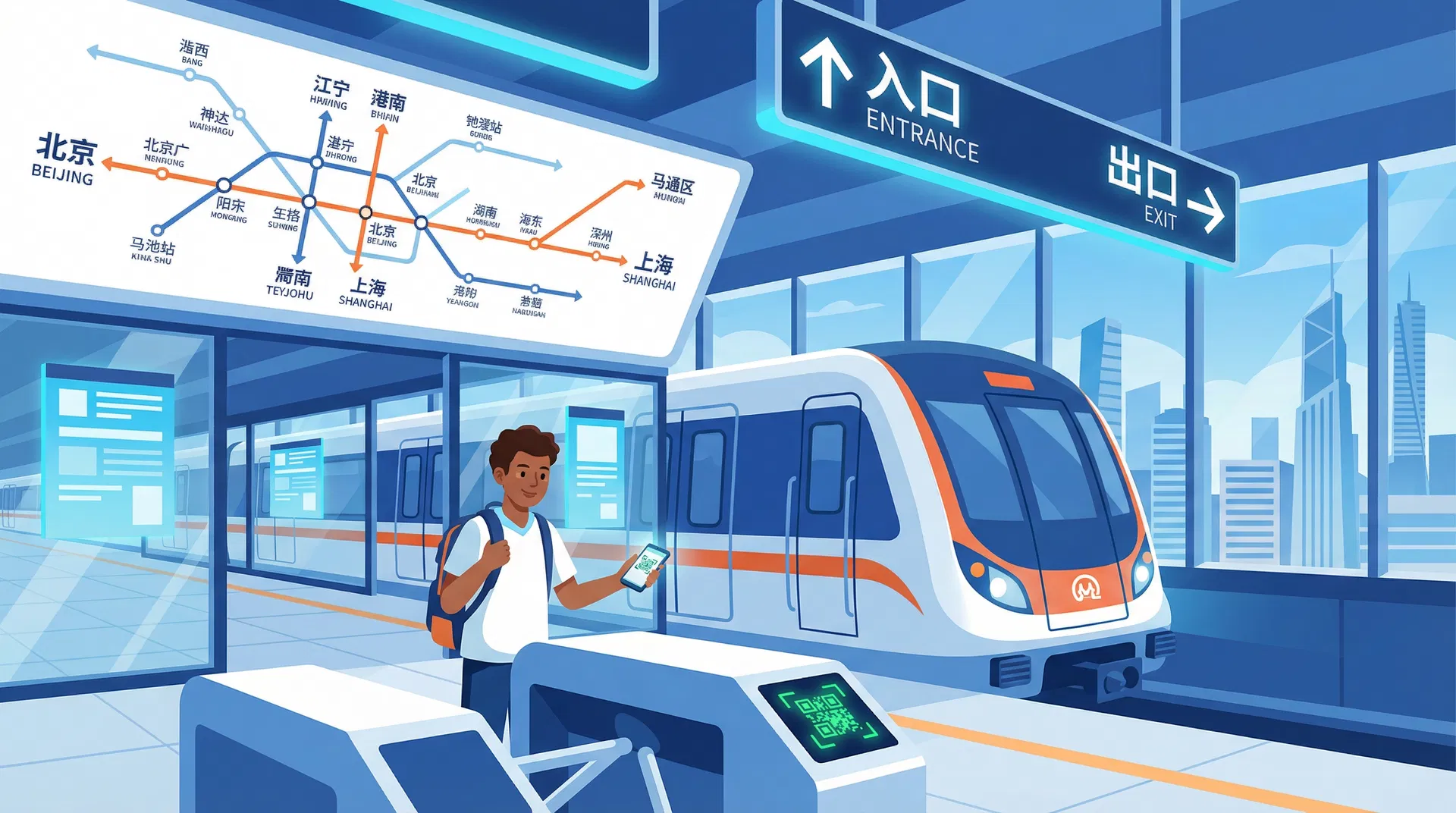
Alipay Transit QR Code: Open Alipay, search for "乘车码" (transit code), and activate the metro QR code for your city. Simply scan the code at the turnstile — no need for tickets or cards. This works in virtually every Chinese city.
WeChat Transit: Similar to Alipay, WeChat offers transit QR codes through its mini-programs. Search for your city's metro mini-program within WeChat.
City-Specific Apps: Most cities have dedicated metro apps (Beijing Subway, Metro大都会 for Shanghai, etc.) that offer route planning, real-time train tracking, and QR code entry.
**Pro tip:** Set up your transit QR code before you need it. The first-time activation requires identity verification, which can take a few minutes. You don't want to be fumbling with your phone during rush hour with a line of impatient commuters behind you.
# Reading Metro Maps and Signs
# Understanding the Map
Chinese metro maps follow the same color-coding conventions used worldwide — each line has a distinct color and number. Station names are displayed in both Chinese characters and Pinyin (romanized Chinese), making them readable even if you don't know Chinese.
Key vocabulary for metro navigation:
- 地铁 (dìtiě) — Metro/Subway
- 站 (zhàn) — Station
- 线 (xiàn) — Line
- 换乘 (huànchéng) — Transfer
- 出口 (chūkǒu) — Exit
- 入口 (rùkǒu) — Entrance
# Navigating Inside Stations
Every station has clear directional signage in Chinese and English. When you enter, follow the signs to your desired line. At transfer stations, look for the orange transfer signs (换乘) that guide you between lines. Each exit is labeled with a letter (A, B, C, D), and stations display maps showing what's near each exit — this is incredibly useful for finding your destination above ground.
# Platform Safety
Chinese metro platforms have platform screen doors (屏蔽门) in most modern stations — glass barriers that open only when the train arrives. This is both a safety feature and an air conditioning efficiency measure. Stand behind the yellow line and wait for passengers to exit before boarding.
# Essential Apps for Metro Travel
# Amap / Gaode Maps (高德地图)
Amap is China's most popular navigation app and arguably the best tool for planning metro journeys. It provides real-time route suggestions, estimated travel times, fare calculations, and even tells you which car to board for the most convenient exit at your destination station. The app works entirely in Chinese, but its map interface is intuitive enough to use with basic Chinese knowledge.
# Baidu Maps (百度地图)
Baidu Maps offers similar functionality to Amap with slightly better English support in major cities. Its metro route planner is excellent, showing multiple route options with time and cost comparisons.
# Apple Maps / Google Maps
Apple Maps works reasonably well in China for basic metro navigation. Google Maps requires a VPN but can be useful for planning. However, neither is as accurate or detailed as the local alternatives for Chinese public transit.
# Metro Etiquette: The Unwritten Rules
Understanding metro etiquette will help you avoid awkward situations and earn respect from local commuters:
Let passengers exit first. This is the golden rule. Stand to the sides of the doors and wait for everyone to exit before boarding. Rushing in while people are still getting off is considered extremely rude (and impractical).
Move to the center of the car. Don't block the doors by standing right at the entrance. Move into the car to make room for others. During rush hour, this isn't just polite — it's necessary.
Give up your seat. Priority seats (marked in a different color) are for elderly passengers, pregnant women, people with disabilities, and those carrying young children. Even if you're sitting in a regular seat, offering it to someone who needs it more is appreciated.
Keep the volume down. While China is generally a louder culture than many Western countries, playing music or videos without headphones on the metro is increasingly frowned upon. Many cities have actually banned this behavior with fines.
No eating or drinking. Most Chinese metro systems prohibit eating and drinking on trains. This rule is strictly enforced in some cities (like Shanghai, where you can be fined) and loosely observed in others.
# Surviving Rush Hour
Rush hour in Chinese metros is an experience unto itself. In major cities, morning rush (7:00-9:00) and evening rush (17:00-19:00) transform the metro into a human sardine can. Here's how to survive:
Time your commute. If your class starts at 9:00, consider leaving 30 minutes earlier to avoid the worst of the crush. Similarly, staying at the library until 19:30 can make your evening commute much more pleasant.
Know your position. At busy stations, stand in the marked queuing areas on the platform. Position yourself near the doors but to the side, ready to step in quickly when space opens.
Protect your belongings. Keep your phone in your front pocket and your bag in front of you. Pickpocketing is rare in Chinese metros, but crowded conditions make it easy to lose things accidentally.
Use the women's priority car. Some cities designate the first or last car as a women's priority car during rush hours. While not strictly enforced, it tends to be less crowded.
# Connecting with Other Transport
# Metro + Bus
Your transportation card works on both metro and buses, and many cities offer transfer discounts when you switch between the two within a certain time window. Buses are essential for reaching areas not covered by the metro, especially near suburban university campuses.
# Metro + Bike Sharing
The combination of metro and shared bikes (Meituan Bike, Hello Bike, Didi Bike) is the ultimate urban mobility solution. Ride a shared bike to the nearest metro station, take the metro to your destination area, then grab another bike for the last mile. A typical shared bike ride costs just 1.5 RMB for 15 minutes.
# Metro + High-Speed Rail
Many metro systems connect directly to high-speed rail stations (高铁站), making weekend trips incredibly convenient. From Beijing, you can reach Tianjin in 30 minutes, Shanghai in 4.5 hours, or Xi'an in 4 hours. From Shanghai, Hangzhou is just 45 minutes away, and Nanjing is about 1 hour.
# Cost-Saving Tips for Students
Monthly passes: Some cities offer monthly passes that provide unlimited rides or significant discounts. Beijing's monthly pass costs 100 RMB for 100 rides. Check if your city offers a student discount.
Off-peak travel: If your schedule allows, traveling outside rush hours is not only more comfortable but sometimes cheaper. Some cities offer off-peak fare discounts.
Cumulative discounts: In cities like Beijing, after spending a certain amount on metro fares in a calendar month, you automatically receive a discount on subsequent rides (typically 20% off after 100 RMB, 50% off after 150 RMB).
Student transportation subsidies: Some universities provide transportation subsidies or discounted metro cards for international students. Check with your university's international student office.
# Safety and Accessibility
Chinese metros are among the safest public spaces in the country. Every station has security checkpoints with bag scanners (similar to airport security but much faster), CCTV coverage throughout, and emergency intercoms on platforms and in trains.
For students with disabilities, most stations have elevators, tactile paving, and wheelchair-accessible gates. However, accessibility varies significantly between newer and older stations. The metro apps mentioned earlier can help you identify accessible routes.
In case of emergency, every train car has an emergency intercom button and emergency door-opening handles. Station staff are trained in first aid and emergency procedures.
# Conclusion
China's metro systems are more than just a way to get from point A to point B — they're a window into the country's remarkable modernization and a daily reminder of the scale at which China operates. As an international student, mastering the metro will save you money, expand your exploration radius, and give you a sense of independence that's hard to achieve otherwise.
Start with the basics: get a transportation card or set up your mobile transit QR code, download a local maps app, and don't be afraid to ask for help. Within a week, you'll be navigating transfers and timing your arrivals like a local. Within a month, you'll wonder how you ever lived without it. Welcome aboard — next stop, your new life in China.