
More than 500,000 international students choose to study in China each year. They come from Southeast Asia, Africa, Central Asia, Latin America, and increasingly from Europe and North America. What drives this choice is not some vague fascination with the East, but a set of concrete, measurable advantages.
This article outlines 10 substantive reasons to study in China — not marketing slogans, but real data and lived experience.
# 1. Tuition Fees: Disproportionately Low for the Quality
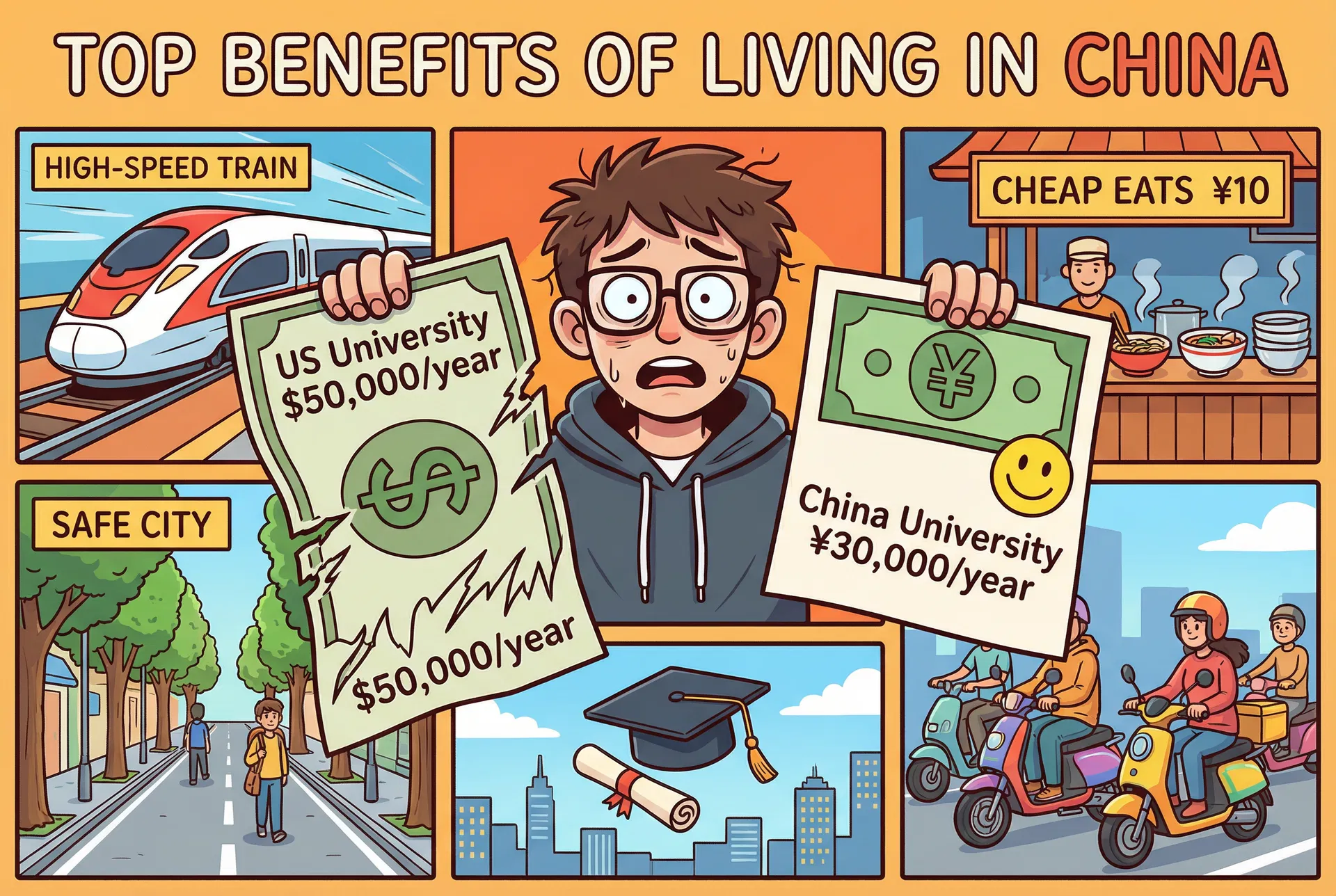
The tuition fees at China's top universities are remarkably low relative to their academic reputation. For a graduate-level STEM program:
| University | Annual Tuition (RMB) | USD Equivalent |
|---|---|---|
| Tsinghua University | ~30,000 | ~4,200 |
| Peking University | ~28,000 | ~3,900 |
| Zhejiang University | ~24,000 | ~3,300 |
| HUST | ~20,000 | ~2,800 |
Comparable-ranked institutions in the US or UK typically charge 8-15 times these amounts. This is not "cheap and cheerful" — it is a historically anomalous price gap that will not stay open forever as Chinese universities continue climbing global rankings.
# 2. Scholarships: Broad Coverage, Relatively Accessible
The Chinese Government Scholarship (CSC) funds over 50,000 international students annually, covering tuition, accommodation, living allowance, and health insurance. It is one of the largest government scholarship programs in the world.
Beyond CSC, there are:
- Provincial government scholarships: Set by individual provinces, with less competition
- University-specific scholarships: Targeted funding for strong applicants
- Confucius Institute scholarships: Dedicated programs for Mandarin learners
For students from developing countries, the barrier to securing a full scholarship is significantly lower than for equivalent programs in the US or UK.
# 3. Safety: An Underrated Advantage
China's public safety record ranks among the highest of any major economy. Violent crime rates are extremely low, and city streets are generally safe late at night. This is not propaganda — it is the consistent feedback from international students who have lived there.
For female students traveling alone, or for students from regions with higher crime rates, this matters enormously. Being able to walk back to the dormitory at midnight, or take a DiDi alone, is a freedom that is simply not available in many countries.
# 4. Mandarin: One of the Most Valuable Second Languages of the 21st Century
Learning Mandarin is the most durable dividend of studying in China. Chinese is the most widely spoken language in the world by native speakers, China is the world's second-largest economy, and its international influence will continue to grow in any foreseeable scenario.
Immersive language environments are the most efficient way to learn. One year of living in China accelerates language acquisition far beyond any classroom. Many students arrive knowing only basic greetings and leave two years later conducting business negotiations in Mandarin.
# 5. High-Speed Rail: China as Your Backyard
China operates the world's largest high-speed rail network, with over 45,000 kilometers of track connecting virtually every major city. Beijing to Shanghai in 4.5 hours, Guangzhou to Chengdu in under 8 hours — journeys that once took a full day now happen in comfort at a fraction of the cost of flying.
For international students, this network turns the entire country into an accessible space for exploration. Long weekends become opportunities to discover Guilin, Xi'an, Chengdu, or Hangzhou from any university city. China's diversity is not something to read about on a map — it is something to experience firsthand.
# 6. Urban Infrastructure: World-Class Daily Experience
The metro systems in China's major cities rival — and often surpass — those of London, Tokyo, or Paris in terms of coverage, punctuality, and modernity. A single metro fare costs 2-6 RMB regardless of distance. Monthly passes offer significant discounts.
Shared bicycles and electric scooters are everywhere, available by scanning a QR code. Food delivery arrives in 30 minutes, almost anywhere, almost any time. Mobile payment penetration approaches 100%, making cash nearly obsolete.
This density of infrastructure reduces the friction cost of daily life to near zero — freeing time and energy for what actually matters.
# 7. Electric Mobility: Green and Economical
China leads the world in electric vehicle adoption. Electric bicycles and scooters are ubiquitous, available second-hand from 800-1,500 RMB, with negligible monthly operating costs.
DiDi's fleet is heavily electrified, and urban bus networks are rapidly following suit. For students, this means extremely low transportation costs alongside a carbon footprint far below that of car commuting in Western cities.
# 8. Career Prospects: Demand for Bilingual, Bicultural Talent
Mandarin proficiency combined with a degree from a recognized Chinese university constitutes a highly competitive profile in today's international job market. Multinational companies with China operations — in technology, finance, international trade, logistics, and manufacturing — actively seek bicultural professionals who can navigate both Chinese and Western professional norms.
The Chinese government has also streamlined work visa procedures for foreign graduates of Chinese universities, recognizing the strategic value of retaining internationally trained talent. For students who invest seriously in Mandarin and building a local professional network, career prospects in China or in China-related roles are substantial and growing.
# 9. Food: Diversity and Affordability Combined
The culinary diversity of China is almost unmatched globally. Sichuan's numbing spice, Cantonese delicacy, Xinjiang's grilled meats, Yunnan's sour heat — each province has its own distinct food culture, and most of it is available in university canteens.
A full meal in a university canteen typically costs 5-15 RMB. A good meal at a local restaurant outside campus runs 20-40 RMB. Even in first-tier cities, daily food expenses are a fraction of what they would be in Europe or North America.
# 10. Personal Growth: An Irreproducible Experience
Studying in China is, ultimately, a transformative personal experience. Navigating daily life in a tonal language, decoding the social codes of a Confucian society, observing from the inside the fastest urban transformation in human history — all of this forges a cultural intelligence and resilience that years on a Western campus simply cannot provide.
Students returning from China describe the experience almost unanimously as one of the most formative periods of their lives. The ability to function in a radically different environment, to build trust across linguistic barriers, and to develop a nuanced understanding of a society frequently caricatured in Western media — these are durable competitive advantages in the global job market.
# Final Reflection
China is not a perfect destination — nowhere is. But for a student evaluating options with clear eyes, the combination of quality education at low cost, a safe environment, exceptional infrastructure, and real career prospects makes it an option that deserves serious consideration — not as a fallback, but as a deliberate, strategic choice.