China trains more doctors than almost any other country in the world. With over 1.4 billion people to serve, its medical education system has evolved into one of the most structured and rigorous pathways to clinical practice anywhere in Asia. For international students considering a medical career in or through China, understanding how the system works — from undergraduate enrollment to independent practice — is essential.
This guide breaks down every stage of the journey: the different degree tracks, the landmark policy reforms, the institutions worth targeting, and what a medical career in China actually looks like in terms of workload, progression, and income.
# The Structure of Medical Education in China
Unlike many Western countries where medicine is a graduate-entry profession, China primarily trains doctors through undergraduate programs that begin immediately after high school. The national college entrance exam (高考, Gaokao) is the gateway, and medical programs are among the most competitive tracks available.
There are three main program lengths, each designed for a different career trajectory:
# The 5-Year Bachelor's Program (五年制本科)
The standard route for most medical students in China. Students complete five years of coursework covering basic sciences, clinical medicine, and a mandatory one-year internship embedded in the final year. Upon graduation, students receive a Bachelor of Medicine degree and are eligible to sit for the National Medical Licensing Examination (执业医师资格考试, Zhiye Yishi Zige Kaoshi).
However, a bachelor's degree alone is increasingly insufficient for employment at top-tier hospitals. Most graduates proceed to postgraduate training or the residency system before becoming fully independent practitioners.
# The 5+3 Integrated Program (本硕连读, *Benshu Liandu*)
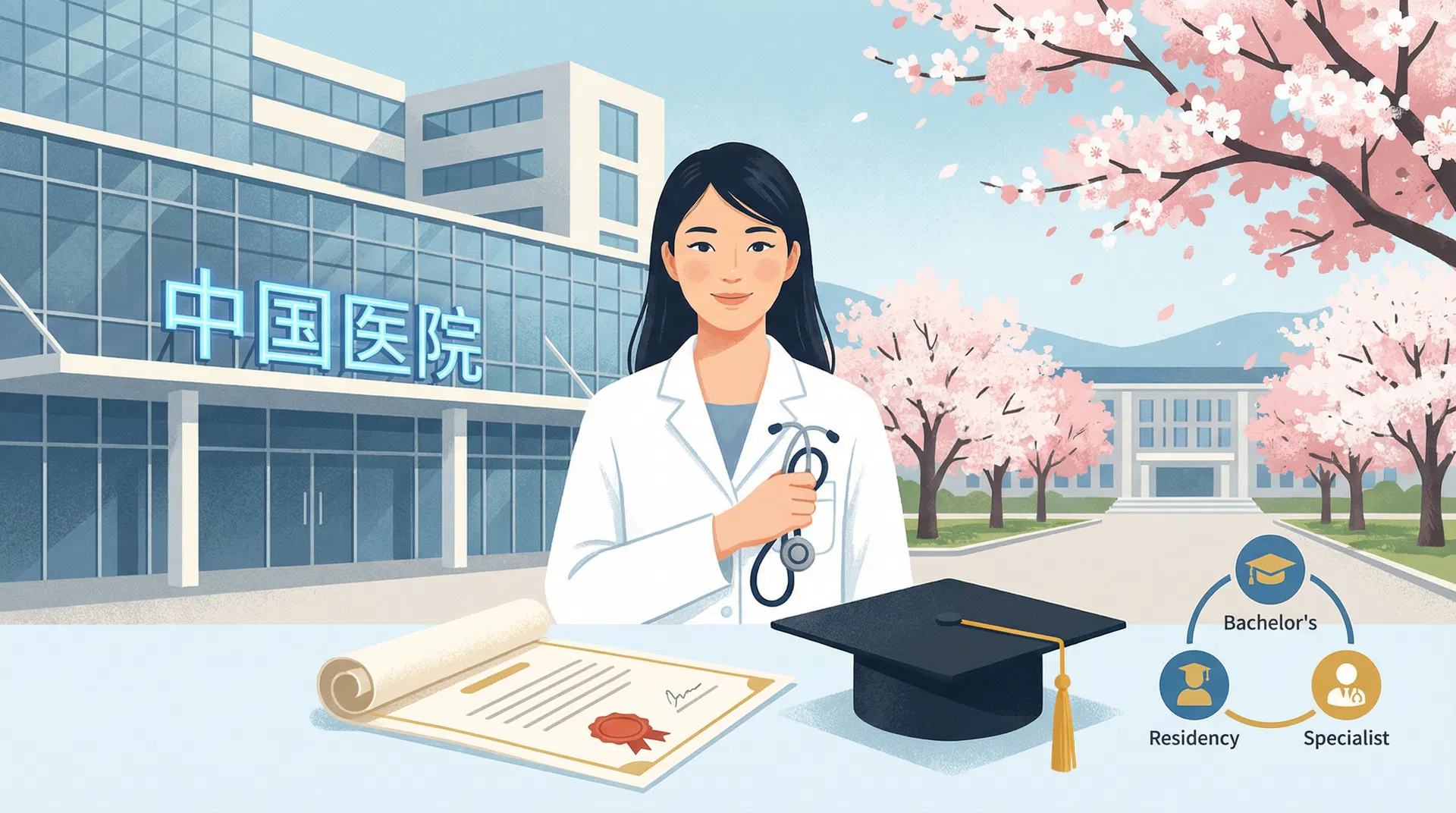
This track combines five years of undergraduate medical education with three years of clinical master's training, totaling eight years. The key innovation is that the three postgraduate years are simultaneously structured as standardized residency training (住院医师规范化培训, Zhuyuan Yishi Guifanhua Peixun, commonly abbreviated as 规培, Guipei). Graduates who complete this pathway exit with both a Master of Medicine degree and a residency completion certificate — a significant efficiency compared to completing the two separately.
The 5+3 model has become the dominant pathway for students aiming to work in urban tertiary hospitals.
# The 8-Year Integrated Program (本硕博贯通, *Benshubo Guantong*)
Reserved for the most academically elite students, the eight-year program leads directly to a Doctor of Medicine (MD) degree — equivalent to a combined bachelor's, master's, and doctoral qualification in clinical medicine. Admission is limited to a small number of top universities, and the program is designed to produce physician-scientists capable of both advanced clinical work and independent research.
Peking Union Medical College (北京协和医学院), widely regarded as China's most prestigious medical institution, is the flagship home of this program. Students who complete the eight-year track are expected to pursue careers in academic medicine, research hospitals, or specialist leadership roles.
# The Three Certificates: What Doctors Need to Practice (三证合一)
A recurring concept in Chinese medical education discourse is 三证合一 (Sanzhen Heyi), or "three certificates unified." To practice medicine independently in China, a doctor must hold all three of the following:
| Certificate | Chinese Name | Issuing Body |
|---|---|---|
| Medical Degree Certificate | 医学学位证书 | University |
| Medical Graduation Certificate | 医学毕业证书 | University |
| Physician Qualification Certificate | 执业医师资格证 | National Health Commission |
Historically, these three documents were obtained through separate processes at different stages of training. The 5+3 reform was partly designed to streamline this: students completing the integrated program and passing the licensing exam can obtain all three certificates upon finishing their residency, rather than accumulating them piecemeal over a decade.
For students in the standard 5-year track, the sequence is: graduate → pass licensing exam → complete residency (规培) → obtain all three certificates → apply for hospital employment. The full process typically takes eight to nine years from high school graduation to independent practice.
# The Residency Training System (住院医师规范化培训, 规培)
Introduced as a national policy in 2015, the standardized residency training system (规培) was a landmark reform in Chinese medical education. Before its introduction, the quality of postgraduate clinical training varied enormously between hospitals and regions. The new system mandated that all medical graduates — regardless of their degree level — complete a standardized three-year residency at an accredited training base (培训基地) before being permitted to practice independently.
Key features of the 规培 system include:
- Duration: Three years of rotational training across clinical departments at a designated tertiary hospital (三级甲等医院, Sanji Jiajia Yiyuan, or "Grade A Tier 3" hospital)
- Stipend: Residents receive a monthly living allowance, though this is typically modest — ranging from approximately ¥2,000 to ¥5,000 per month depending on the city and hospital
- Examination: Completion requires passing both a clinical skills assessment and a written theory examination administered by the National Health Commission
- Integration with master's programs: Students in the 5+3 track complete their residency simultaneously with their master's degree, earning both qualifications at the end of year eight
The 规培 system has been praised for standardizing clinical competency across China's vast and uneven healthcare landscape. It has also been criticized for placing significant financial and personal strain on young doctors, who often work long hours for limited compensation during the training period.
# Top 10 Medical Schools in China
The following institutions are consistently ranked among China's elite for medical education, based on research output, clinical training quality, and national reputation:
| Rank | Institution | Location | Notable Strength |
|---|---|---|---|
| 1 | Peking Union Medical College (北京协和医学院) | Beijing | 8-year MD program, research medicine |
| 2 | Fudan University Shanghai Medical College (复旦大学上海医学院) | Shanghai | Clinical medicine, oncology |
| 3 | Peking University Health Science Center (北京大学医学部) | Beijing | Basic sciences, public health |
| 4 | Shanghai Jiao Tong University School of Medicine (上海交通大学医学院) | Shanghai | Surgery, affiliated hospital network |
| 5 | Zhejiang University School of Medicine (浙江大学医学院) | Hangzhou | Integrated research and clinical training |
| 6 | Tongji Medical College, Huazhong University of Science and Technology (华中科技大学同济医学院) | Wuhan | Cardiology, infectious disease |
| 7 | West China School of Medicine, Sichuan University (四川大学华西医学中心) | Chengdu | Surgery, stomatology |
| 8 | Sun Yat-sen University Zhongshan School of Medicine (中山大学中山医学院) | Guangzhou | Tropical medicine, ophthalmology |
| 9 | Capital Medical University (首都医科大学) | Beijing | Neurology, affiliated hospital network |
| 10 | Nanjing Medical University (南京医科大学) | Nanjing | Reproductive medicine, public health |
Admission to these institutions through the Gaokao requires scores in the top percentile of each province. International students may apply through separate admission channels, and some schools offer MBBS programs taught in English, particularly for students from South and Southeast Asia.
# Career Progression: From Resident to Chief Physician
The career ladder for Chinese doctors is structured and title-based, with each promotion requiring a combination of years of experience, examination performance, and published research. The standard progression is as follows:
Resident Physician (住院医师) → Attending Physician (主治医师) → Associate Chief Physician (副主任医师) → Chief Physician (主任医师)
Each step typically requires three to five years at the previous level, along with passing professional title examinations (职称考试) and, at higher levels, demonstrating research output. The path from completing residency to reaching Chief Physician status commonly takes fifteen to twenty years of clinical practice.
Most doctors in China work within the public hospital system, which is organized into three tiers. Tier 3 hospitals (三级医院), particularly those with the "Grade A" (甲等) designation, are the most prestigious and competitive employers. These institutions — such as Peking Union Medical College Hospital, Ruijin Hospital in Shanghai, and West China Hospital in Chengdu — attract patients from across the country and offer the most advanced training environments.
# Income Levels: What Doctors Earn in China
Doctor compensation in China has been a subject of significant public debate. Official salaries at public hospitals have historically been low relative to the years of training required, though the picture is more complex when total compensation is considered.
Based on data from 2024–2025 reform discussions and hospital salary surveys:
| Title | Tier 3 Hospital (Major City) | National Average |
|---|---|---|
| Resident Physician (住院医师) | ¥8,000–¥15,000/month | ¥5,000–¥10,000/month |
| Attending Physician (主治医师) | ¥15,000–¥25,000/month | ¥10,000–¥18,000/month |
| Associate Chief Physician (副主任医师) | ¥20,000–¥35,000/month | ¥15,000–¥25,000/month |
| Chief Physician (主任医师) | ¥25,000–¥50,000+/month | ¥20,000–¥30,000/month |
Several provinces have introduced salary reform pilots modeled on the Sanming Medical Reform (三明医改), which sets transparent annual base salaries: ¥300,000 for Chief Physicians, ¥250,000 for Associate Chiefs, ¥200,000 for Attending Physicians, and ¥150,000 for Residents. These figures represent a significant improvement over historical norms and signal the direction of national policy.
It is worth noting that income varies substantially by specialty. Surgeons, anesthesiologists, and radiologists tend to earn more than general practitioners. Geographic location also matters considerably: a Chief Physician at a top Shanghai hospital may earn two to three times the equivalent salary at a county hospital in a less-developed province.
# Practical Considerations for International Students
International students interested in studying medicine in China should be aware of several practical factors:
Language requirements: Most medical programs at top universities are conducted in Mandarin Chinese. Students typically need to complete one to two years of intensive Chinese language study before beginning clinical coursework. Some institutions offer English-medium MBBS programs, but these are generally considered less competitive for employment within China's hospital system.
Licensing recognition: A Chinese medical degree is not automatically recognized in other countries. Students who wish to practice medicine outside China — in their home country or elsewhere — should research the specific recognition and licensing requirements of their target jurisdiction before enrolling.
Residency competitiveness: Matching to a desirable 规培 training base at a top-tier hospital is competitive. Students from elite medical schools have a significant advantage in securing placements at Grade A Tier 3 hospitals in major cities.
Long training timeline: The full journey from high school graduation to independent specialist practice in China is typically twelve to fifteen years, accounting for undergraduate education, the 规培 residency, and the years required to reach Attending Physician status. This is comparable to or longer than medical training timelines in the United States, United Kingdom, or Australia.
# Final Thoughts
China's medical education system is demanding, structured, and increasingly standardized. The 5+3 integrated pathway and the 规培 residency system have brought greater consistency to clinical training across a country of enormous geographic and institutional diversity. For students with the academic preparation and language commitment to navigate this system, the rewards include access to world-class clinical environments, exposure to a patient population of unmatched scale and diversity, and a career in one of the world's most rapidly modernizing healthcare systems.
The path is long. The competition is intense. But for those who complete it, the professional foundation is among the most rigorous available anywhere in the world.