
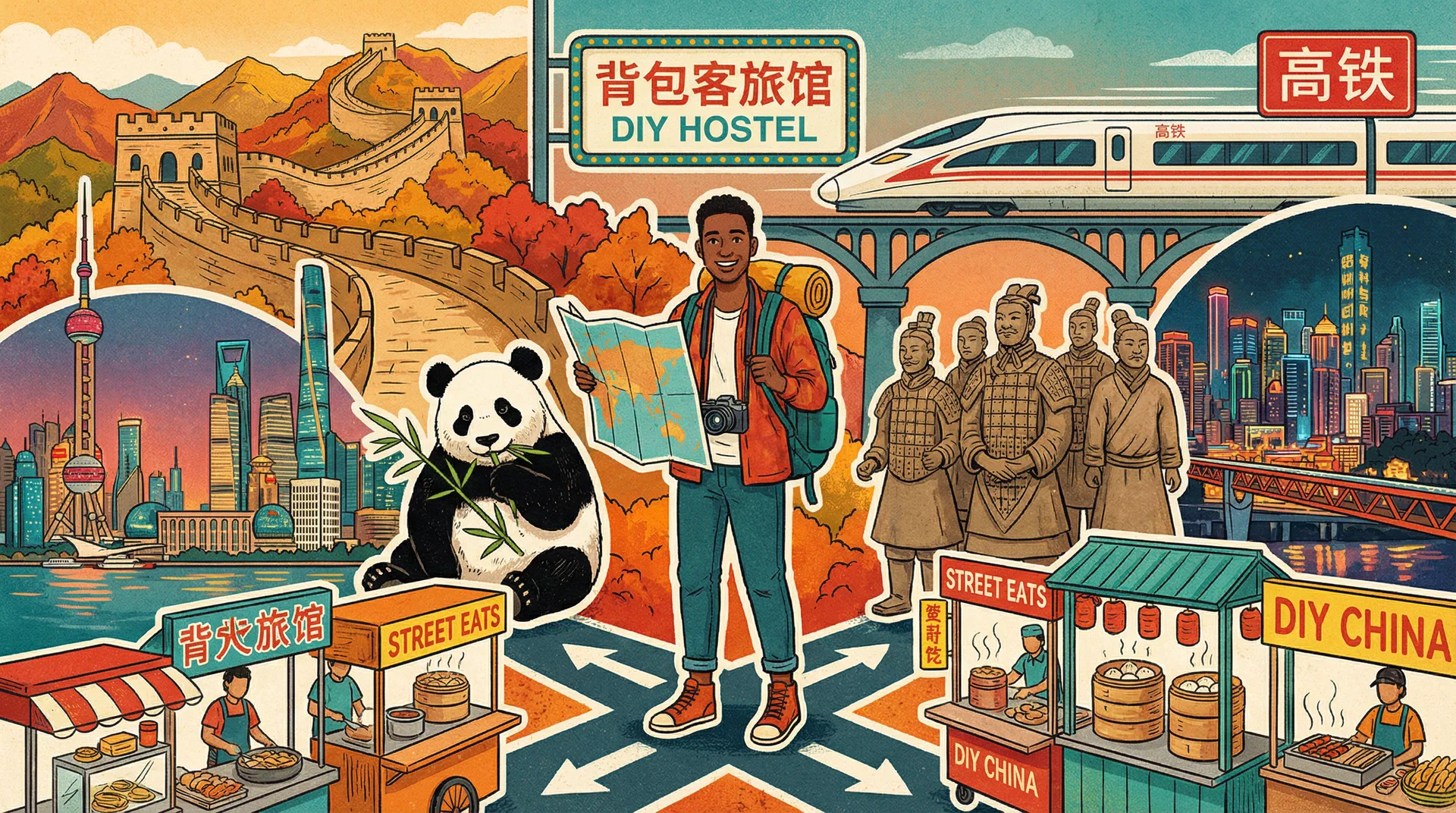
China is not a single destination — it is a continent compressed into one country. From the frozen tundra of Harbin to the tropical beaches of Hainan, from the Tibetan plateau to the neon-lit streets of Shanghai, every province offers a landscape, cuisine, and culture that feels entirely its own. For international students already living in China, the country is a travel playground that most visitors never get to explore at this depth. This guide will help you plan a confident, independent journey across China without a tour group.
# Why DIY Travel in China Works
Independent travel in China has never been easier. The high-speed rail network now covers over 45,000 kilometres, connecting nearly every major city. Domestic flights are affordable and frequent. Mobile payment (支付宝 Alipay and 微信支付 WeChat Pay) is accepted almost everywhere, and most major cities have English signage in metro stations and airports. As a student already living in China, you have a significant advantage: a local SIM card, a working bank card, and a basic understanding of how things work.
# Top Destinations for Independent Travellers
China's most popular destinations each offer a completely different experience. Here is a brief introduction to five cities that are particularly well-suited for first-time independent travellers:
Beijing (北京) — The capital is a living museum of Chinese civilisation. The Great Wall, the Forbidden City (故宫), the Temple of Heaven, and the hutong alleyways of Dongcheng are all within reach of the city's excellent metro system. Beijing rewards slow exploration; plan at least three to four days.
Shanghai (上海) — China's most cosmopolitan city blends Art Deco architecture on the Bund with futuristic towers in Pudong. The French Concession (法租界) is ideal for café-hopping, and the city's food scene is among the best in Asia. Shanghai is also an excellent gateway for day trips to Suzhou and Hangzhou.
Chengdu (成都) — The capital of Sichuan province moves at a slower pace than Beijing or Shanghai, and that is precisely its charm. Visit the Giant Panda Breeding Research Base (大熊猫繁育研究基地) in the morning, spend the afternoon in the teahouses of Jinli Ancient Street (锦里), and end the evening with a hotpot (火锅) that will recalibrate your understanding of spice. Chengdu is also the jumping-off point for trips to Jiuzhaigou and Leshan.
Chongqing (重庆) — Built across steep hills at the confluence of the Yangtze and Jialing rivers, Chongqing is one of China's most visually dramatic cities. The Hongya Cave (洪崖洞) lit up at night, the cable car crossing the Yangtze, and the endless layers of elevated highways make it feel like a city from a science fiction novel. The hotpot here is even more intense than Chengdu's.
Xi'an (西安) — The eastern terminus of the ancient Silk Road and home to the Terracotta Army (兵马俑), Xi'an is where Chinese history becomes tangible. Walk the well-preserved Ming Dynasty city wall at sunset, explore the Muslim Quarter (回民街) for lamb skewers and pomegranate juice, and spend a morning at the Shaanxi History Museum. Xi'an is a city that repays every hour you give it.
# Getting Around: Planes and High-Speed Rail
For distances under 800 kilometres, the high-speed rail (高铁, gāotiě) is almost always the better choice. Trains depart on time, seats are comfortable, and city-centre stations mean no long airport transfers. The Beijing–Shanghai route, for example, takes around four and a half hours by high-speed rail — comparable to flying once you account for check-in and transit time.
For longer distances — Chengdu to Beijing, Kunming to Shanghai — domestic flights are more practical. Chinese carriers such as Air China (国航), China Eastern (东航), and China Southern (南航) offer competitive fares, especially when booked two to three weeks in advance through platforms like Ctrip (携程) or Qunar (去哪儿).
Booking tips:
- Use the 12306 app or website for train tickets. The app requires a Chinese ID or passport registration, so set it up before your first trip.
- For flights, Ctrip (携程) and Fliggy (飞猪) offer English interfaces and accept international credit cards.
- Book popular routes — especially during Golden Week (黄金周) in October and Chinese New Year — at least two to three weeks in advance, as seats sell out quickly.
# Accommodation: International Chains and Domestic Brands
Major Chinese cities have a full range of accommodation options, from budget hostels to luxury five-star hotels. One notable feature of China's hotel market is that international luxury brands are significantly more affordable here than in their home markets. The Ritz-Carlton in Chengdu (成都丽思卡尔顿), for example, is widely regarded as one of the most competitively priced Ritz-Carlton properties in the world. Similar value can be found at the Four Seasons in Guangzhou and the Waldorf Astoria in Shanghai.
For mid-range travellers, domestic chains offer reliable quality at excellent prices:
| Brand | Tier | Typical Price Range |
|---|---|---|
| 亚朵 (Atour) | Upper-midscale | ¥300–600/night |
| 全季 (Ji Hotel) | Midscale | ¥200–400/night |
| 汉庭 (Hanting) | Economy | ¥120–250/night |
| 如家 (Home Inn) | Economy | ¥100–200/night |
Important note for international travellers: In China, not all hotels are licensed to accommodate foreign nationals (外宾). Hotels that accept foreigners must be registered with the local public security bureau (公安局). When booking, look for properties that explicitly state they accept foreign guests, or confirm directly with the hotel before arrival. International chain hotels and most mid-to-upper-range domestic brands in major cities will have no issue. In smaller cities or rural areas, it is advisable to check in advance.
# Public Transport Within Cities
Every major Chinese city has a modern metro system (地铁, dìtiě) that is clean, punctual, and inexpensive. Single journeys typically cost between ¥2 and ¥8 depending on distance. Most metro apps and ticket machines offer English language options.
For shorter distances, DiDi (滴滴) — China's equivalent of Uber — is reliable and affordable. The DiDi app has an English interface and allows you to enter destinations in English or pinyin. Taxi hailing from the street is also common in most cities.
For destinations beyond the city — rural villages, mountain parks, or smaller towns — consider joining a local day tour or multi-day tour group (跟团游). These are widely available through Ctrip, local travel agencies, or even your university's student union. A two-day tour to Jiuzhaigou from Chengdu, or a day trip to the Terracotta Army from Xi'an, typically costs between ¥200 and ¥600 per person including transport and a guide. This is often the most practical option for reaching destinations where public transport is limited or infrequent.
# Practical Tips for a Smooth Trip
Dietary requirements: China's mainstream tourism infrastructure does not routinely accommodate special dietary needs. Halal options (清真, qīngzhēn) are available in cities with significant Muslim populations — Xi'an, Lanzhou, Urumqi — and vegetarian restaurants (素食餐厅) exist in most major cities, particularly near Buddhist temples. However, if you follow a strict diet — vegan, gluten-free, severe allergies — it is worth preparing a written card in Chinese explaining your requirements, and researching specific restaurants in advance rather than relying on improvisation.
Travel insurance: China's public hospitals are efficient and relatively affordable, but medical costs can accumulate quickly in the event of a serious illness or accident. A basic travel insurance policy covering medical evacuation is a sensible precaution, particularly for trips involving outdoor activities, mountain hiking, or remote areas. Many universities offer group travel insurance for students; check with your international student office before purchasing a separate policy.
Shopping: China's markets, night bazaars, and shopping streets are genuinely enjoyable, and prices for clothing, electronics, and souvenirs are often lower than in your home country. That said, it is worth setting a budget before you arrive at a market. Bargaining (讲价, jiǎngjià) is expected at street markets and smaller shops, but not in branded stores or shopping malls. A useful rule of thumb: start at around 40–50% of the asking price and negotiate from there.
Connectivity: A Chinese SIM card with a data plan is essential for navigation, translation, and booking. If you are already a student in China, you likely have one. If travelling from abroad, consider purchasing a tourist SIM at the airport. Note that Google Maps, WhatsApp, and most Western social media platforms are not accessible in mainland China without a VPN.
Payment: Cash (人民币, RMB) is still accepted everywhere, but mobile payment via Alipay (支付宝) or WeChat Pay (微信支付) is the dominant method in most cities. International visitors can now link a foreign Visa or Mastercard to Alipay's international version, which has significantly simplified payments for non-Chinese residents.
# A Note on Timing
China's travel calendar has two major peak periods: Golden Week in early October (国庆黄金周) and Chinese New Year (春节). During these periods, popular destinations are extremely crowded, transport tickets sell out weeks in advance, and hotel prices surge. If possible, plan major trips outside these windows — late March to May and September are generally ideal in terms of weather, crowds, and cost.
China rewards the traveller who is willing to move slowly, eat adventurously, and embrace the occasional moment of productive confusion. As an international student, the country is already home — and that makes every journey through it a little more personal than a standard tourist itinerary.